*With apologies to B.H.O.
My friends and readers know that I've been in a relationship (supposedly over) for the last four years that has at its basis the understanding that it has no future. Nonetheless, I've been hoping for a different outcome all this time. This post is about giving up that hope.
The phrase "giving up hope" usually has a negative connotation. It's a surrender, a failure. But today I suddenly saw it as an affirmation. For me, it's the acceptance of the present, the act of choosing reality over an ephemeral possibility.
In what state would I rather exist: wishing, waiting, worrying, wondering whether something might occur, or deciding that I like the way things are without it?
This doesn't mean that I don't still want it. If the rat chooses not to push the lever that may deliver a shock in order to get the treat at the end, it doesn't mean he doesn't still want the treat. (And it doesn't mean I feel like a rat, though I might empathize with him.) I don't know how to consciously change a desire, and I'm realizing that that is not the best use of my energy.
That was where my thinking was faulty. I thought I needed to not want to be with him, and was despairing of ever not caring. But it's that I needed to choose to give up the hope that we'd work things out. The anxiety is gone now. I'm not giving up, I'm choosing to accept the present (without him in my life) and enjoying that peace.
OK, for those of you with a short attention span or no time, you can stop reading here. For those who would like to meditate on this further, here's a better writer than me about it.
Pema Chodron, the Buddhist nun and teacher, puts it this way:
"The first noble truth
of the Buddha is that when we feel suffering, it doesn't mean that something
is wrong. What a relief. Finally somebody told the truth.
Suffering is part of life, and we don't have to feel it's happening because
we personally made the wrong move. In reality, however, when we feel
suffering, we think that something is wrong. As long as we're addicted
to hope, we feel that we can tone our experience down or liven it up or
change it somehow, and we continue to suffer a lot.
The word in Tibetan
for hope is rewa; the word for fear is dokpa. More commonly, the
word re-dok is used, which combines the two. Hope and fear is a feeling
with two sides. As long as there ís one, there ís always the other.
This re-dok is the root of our pain. In the world of hope and fear,
we always have to change the channel, change the temperature, change the
music, because something is getting uneasy, something is getting restless,
something is beginning to hurt, and we keep looking for alternatives.
In a nontheistic state
of mind, abandoning hope is an affirmation, the beginning of the beginning.
You could even put "Abandon hope" on your refrigerator door instead of
more conventional aspirations like "Every day in every way I'm getting
better and better."
Hope and fear come
from feeling that we lack something; they come from a sense of
poverty. We can't simply relax with ourselves. We hold on to
hope, and hope robs us of the present moment. We feel that someone
else knows what ís going on, but that there ís something missing in us, and
therefore something is lacking in our world."
And finally, she writes:
"When we talk about
hopelessness and death, we're talking about facing the facts.
No escapism. We may still have addictions of all kinds, but we cease
to believe in them as a gateway to happiness. So many times we've
indulged the short-term pleasure of addiction. We've done it so many
times that know that grasping at this hope is a source of misery that makes
a short-term pleasure a long-term hell.
Giving up hope is
encouragement to stick with yourself, to make friends with yourself, to
not run away from yourself, to return to the bare bones, no matter what's
going on. [my emphasis] Fear of death is the background of the whole thing.
It's why we feel restless, why we panic, why there's anxiety. But
if we totally experience hopelessness, giving up all hope of alternatives
to the present moment, we can have a joyful relationship with our lives,
an honest, direct relationship, one that no longer ignores the reality
of impermanence and death."
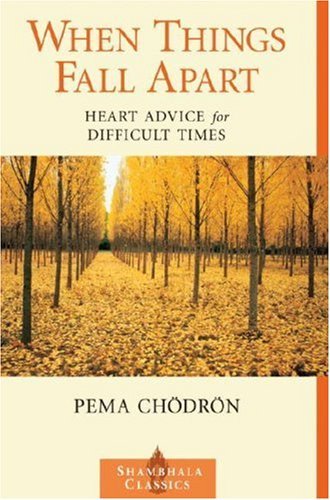
Excerpted from When Things Fall Apart: Heart Advice for
Difficult Times, by Pema Chodron


.html?/photos/uncategorized/2008/09/29/mantra_plaque.jpg "Mantra_plaque")


Recent Comments